Uncategorized

ACM IMX’25 in Niteroi/Rio de Janiero!

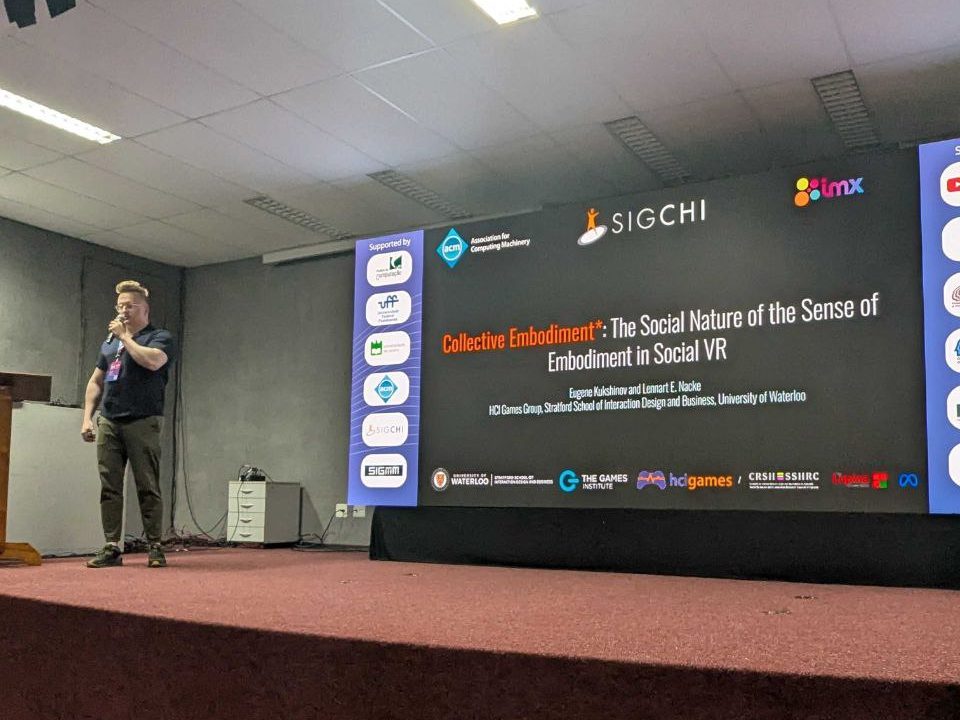
In this study, we think we have discovered a new phenomenon specific to social virtual environments. It is closely related to the subjective individual sense of embodiment in VR, but it is not the same. It is an intersubjective state in the sense that it depends on what others do, look like or what meanings they negotiate together. It is a sensory and a symbolic state of being a virtual group.

Eugene Kukshinov and Lennart E. Nacke. 2025. Collective Embodiment, or the Social Nature of the Sense of Embodiment in Social VR. In Proceedings of the 2025 ACM International Conference on Interactive Media Experiences (IMX ’25). Association for Computing Machinery, New York, NY, USA, 187–199. https://doi.org/10.1145/3706370.3727895

Standard
Uncategorized

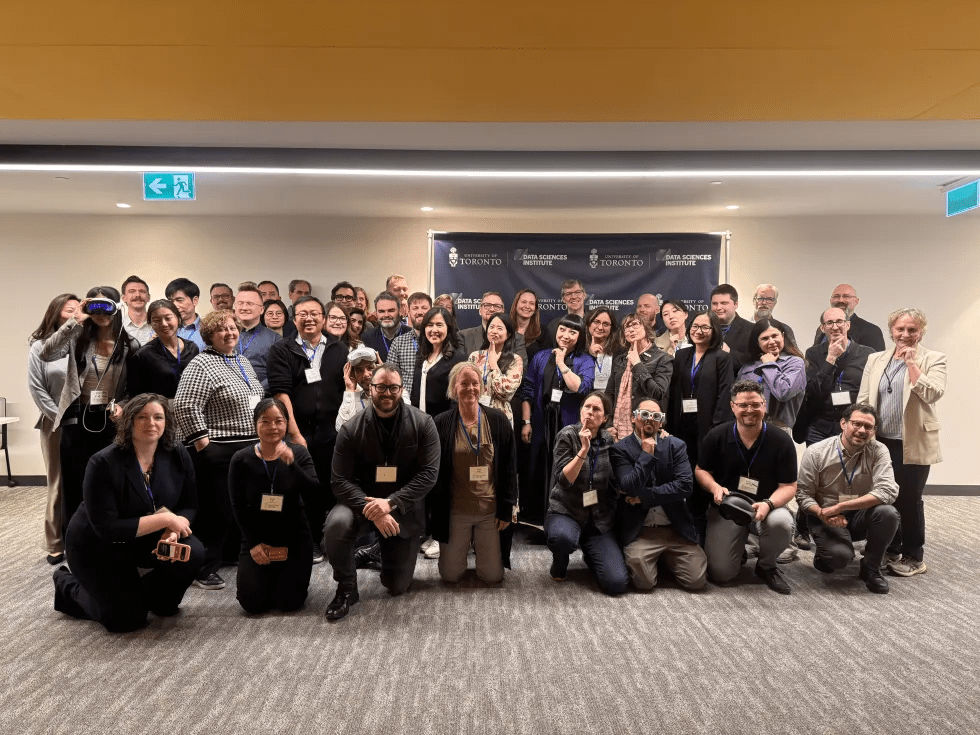
On attending “Questioning Reality 2025” at the Data Sciences Institute

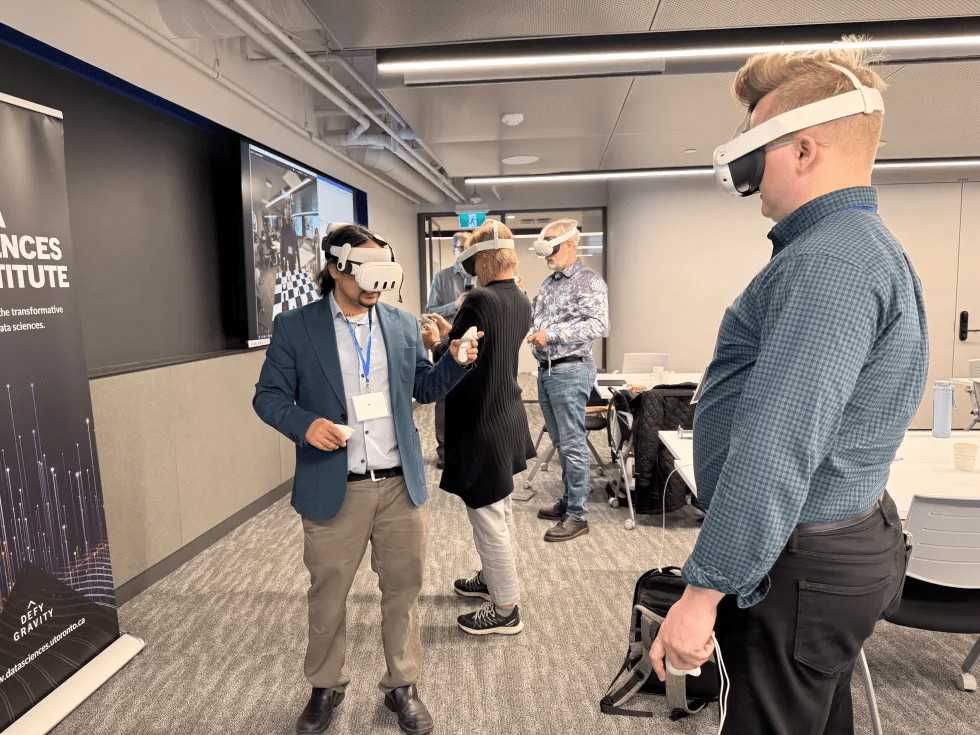
Last week, I had the chance to attend Questioning Reality 2025 at the Data Sciences Institute at the University of Toronto. The event was packed and incredibly well-organized, creating a fast-paced environment for real conversations about the future of VR, AR, and social interaction.

One of the highlights for me was the amount of direct networking built into the schedule—casual breakfasts, play sessions with VR prototypes, and focused workshops where you could actually have meaningful discussions. The sessions were dense but energizing, with constant opportunities to meet researchers, industry experts, and designers pushing boundaries in XR.

The organizers really nailed the balance between structure and openness, making space for both big-picture brainstorming and critical discussion. Huge thanks to the team and the Alfred P. Sloan Foundation for supporting such a dynamic and genuinely inspiring gathering.

Standard
publication

IEEE VR’25 (Best Paper Award!) and Interacting With Computers papers accepted!

First, our final analysis of the presence questionnaires use was published in the Interacting with Computers! More than 2/3 of the papers that use questionnaires to measure presence modified the measures, and most of them did not explain reasons for doing so or revalidated them.


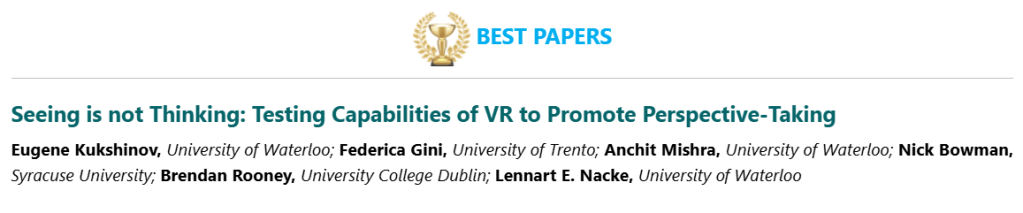
Second, our study about perspective-taking in VR was accepted to the IEEE VR as a full paper! As our results show, VR, whether in 1PP or 3PP, does not naturally promote perspective-taking as a process of thinking about other’s thoughts and feeling.

It also won the best paper award!

Standard
publication

New publication in Human Studies!

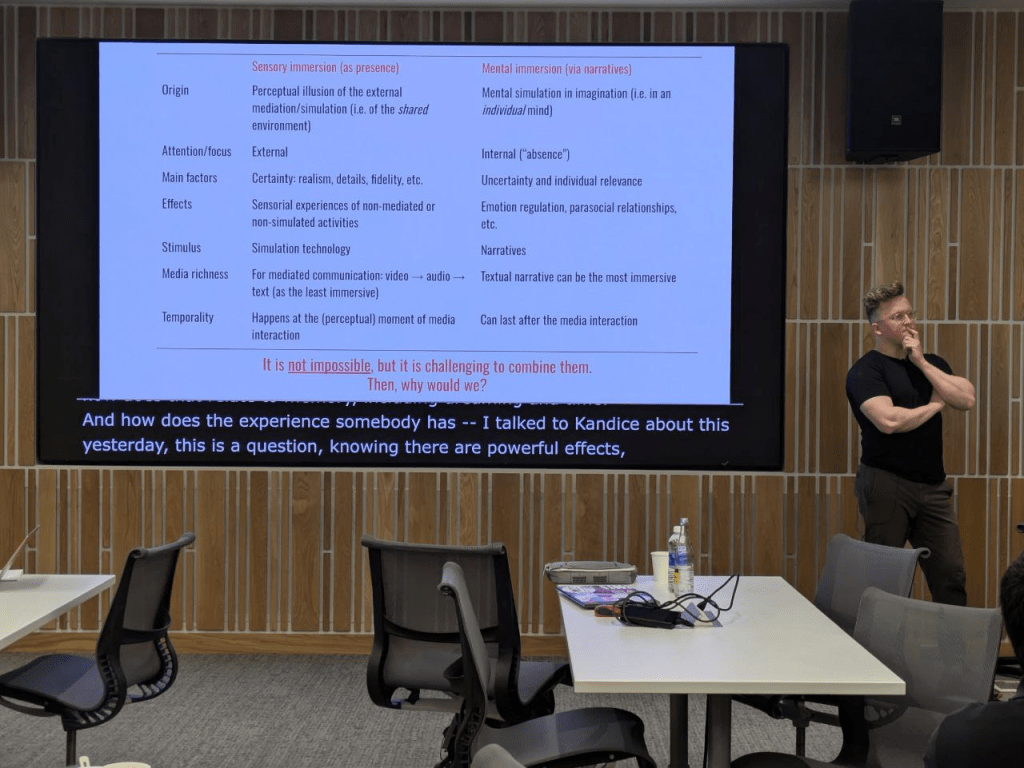
In this paper, I am analyzing how video game players can experience different combinations of both sensory immersion in a game’s simulation (or presence) and mental immersion into their narrative.

One of the most intriguing results is the “It is not me” mechanic that players sometimes use to distance themselves from certain unpleasant events in games and then translate them into characters that they embody via avatars.

Kukshinov, E. (2024). It’s (not) me: Dynamic Nature of Immersive Experiences in Video Game Play. Human Studies. https://doi.org/10.1007/s10746-024-09768-9

Standard
publication, talk

New publication and a public talk!

Kukshinov, E. (2024) Unestablished Boundaries: The Capabilities of Immersive Technologies to Induce Empathy, Tell Stories, and Immerse. Media and Communication. Volume 12 https://doi.org/10.17645/mac.8423

  • In this paper, I discuss how ‘immersive’ technologies do not inherently immerse users; they do, however, simulate things.
  • I have also discussed this topic, challenges of the immersive technologies, at the Newhouse Impact Summit in Syracuse University, NY (On August 1-2, 2024). You can access the program of the event here.
Standard
publication

Frontiers in Virtual Reality Publication!

MacArthur, C., Kukshinov, E., Harley, D., Pawar, T., Modi, N., & Nacke, L. E. (2024). Experiential Disparities in Social VR: Uncovering Power Dynamics and Inequality. Frontiers in Virtual Reality5 https://doi.org/10.3389/frvir.2024.1351794

The paper investigates how Social Virtual Reality (SVR) environments both reflect and reinforce social inequalities, particularly those related to race and gender. The study takes a critical, intersectional approach to examine how existing power dynamics shape interactions and individual experiences within these virtual spaces.

Using qualitative survey data, the authors explore disparities in how dominant and marginalized groups navigate key SVR affordances, such as expectations around perceived anonymity, the limited customization of avatars, and practices related to self-representation and embodied social interactions. The findings highlight how virtual environments can reproduce offline power structures, often marginalizing non-dominant identities.

The paper emphasizes the need for a deeper engagement with the ways social inequalities persist in virtual worlds and calls for more inclusive design practices in SVR.

Standard