
Title: Visual familiarity as an uncertainty reduction strategy for social presence represented via non-verbal communication in the audio-mediated channel
This project focuses on presence, which is a psychological state or a perceptual illusion of non-mediation (see Lombard & Ditton, 1997) which basically means that when we feel presence while interacting with media we do not recognize on some level the role of the technology in our experiences. Therefore, mediated communication with others can be experienced as non-mediated due to presence or, specifically, social presence.
I came up with this project even before I got to Temple to work with Dr. Matthew Lombard (who was basically for me an incarnation of presence research). I was thinking about how presence can be stimulated without advancing the technology, how it can be observed (to measure it behaviorally instead of self-reporting it), and finally how all of that can be studied around less ‘immersive’ media technology, such as audio channel.
So, the main goal of this project was to bring conceptual clarity and methodological diversity to the presence scholarship, while also to test one of the contextual factors of presence, which are often left unnoticed. Methodologically speaking, I suggested that non-verbal communication, visually unavailable to the communicators during audio conversations, can be an indicator of the sense of social presence that we can observe due to the principle of “behavioral realism”. But, it is not that we feel presence every time when we talk via audio channel. I suggest that it can be a matter of perceptual certainty that constitutes presence in many ways. In other words, there is a higher chance to feel presence if we are familiar with the person we talk on the phone. So, people who are familiar with a person, thus having a more certain mental image of them, will feel more social presence and, therefore, communicate information non-verbally more frequently.
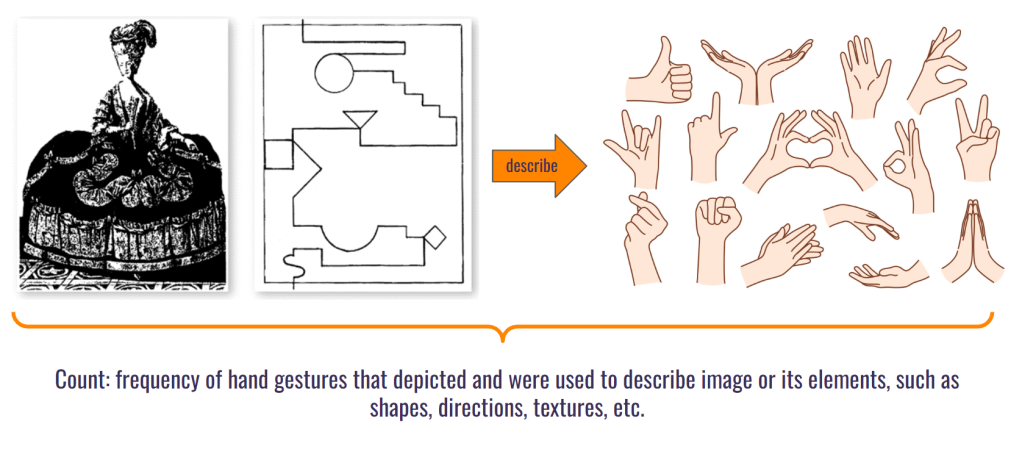
As a result, I asked participants to describe highly encoded images that stimulate gestures, and then I counted how often they gestured to explain these images:
 Eugene Kukshinov, PhD