
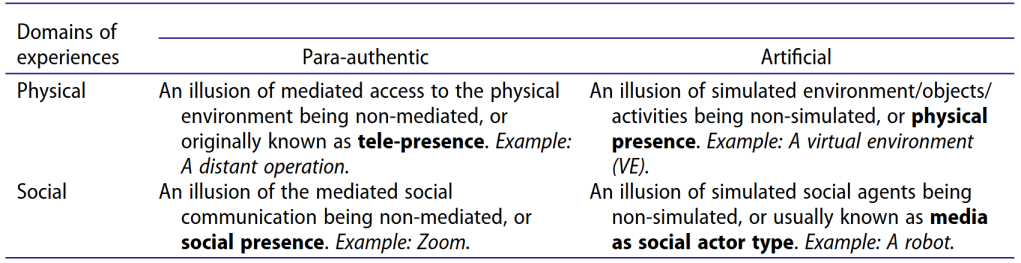
My approach to presence conceptualization aims to integrate any media technologies that can afford presence, which includes more than just VR. I use the definition by Lombard and Ditton (1997), which describes presence as a “perceptual illusion of non-mediation” as a basis to clarify Lee’s (2004) systematic approach.
As a result, the umbrella definition of general presence that I use is “perceptual illusion of non-simulation and/or non-mediation” (Kukshinov, 2024) because mediation is not enough to describe artificial experiences of using technology (such as VR). This approach also helps to exclude self-presence relying on the possibilistic model of consciousness and dual view on immersive experiences.
See: Kukshinov, E. (2024). Presence, (re)focused and explicated. The Communication Review, 1–22. https://doi.org/10.1080/10714421.2024.2366684
Factors:
My approach is that presence, as a perceptual illusion, can be affected by anything that shapes perception (and/or attention). It can include, at least, four sides: content (as in VE), medium (as in HMD), context (as in light in the room), and individual factors (such as previous experience or mood). Or, in other words, it matters what was perceived, how, by whom, and in what context. Considering that technology-related factors dominate the presence discourse, I focus on contextual and individual factors because presence is in the end a psychological state:
 Eugene Kukshinov, PhD